
 Written by
 The maps are red again.
They say it is seasonal. They say it is cyclical. They say it has happened before.
And technically, that is true.
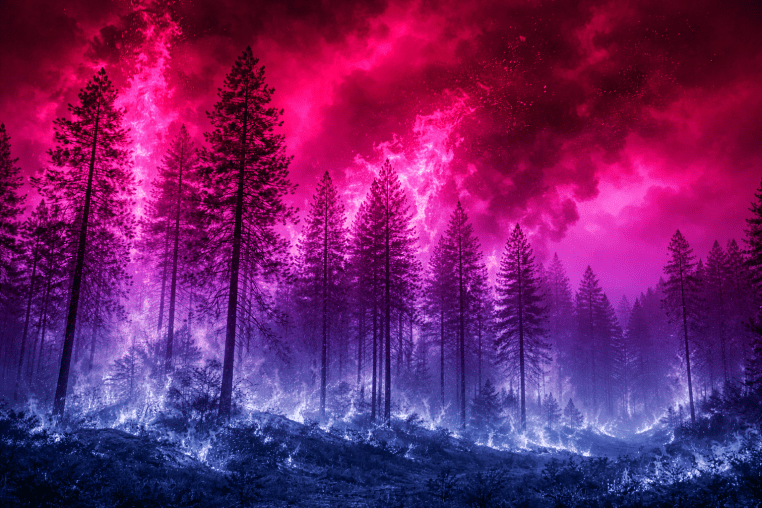
Across the Southern Hemisphere — from the dry interiors of Australia to the forests of South America and the southern reaches of Africa — temperatures have broken records that were not supposed to fall this quickly. Heatwaves have stretched longer than models projected. Wildfires have burned hotter, faster, and with a persistence that feels less accidental and more structural.
On paper, this is climate variability.
In practice, it feels like pressure.
Entire regions have recorded temperature anomalies well above historical averages. Fire seasons have expanded beyond their traditional boundaries. Nights that once brought relief now trap heat close to the ground. Satellite imagery shows smoke plumes thick enough to redraw the horizon.
Officials call it extreme weather.
Observers call it a pattern.
Even without the coming Ring of Fire — the annular eclipse that will carve its bright perimeter across the sky — the signs are already here. The eclipse may be dramatic, but it is not the first signal.
The heat came first.
The atmosphere has been behaving as if something is subtly altering the equilibrium — a faint but persistent imbalance in circulation, pressure systems, and seasonal timing. Ocean temperatures have shown irregular spikes. Jet streams have drifted. Fire behavior has grown unpredictable, almost erratic.
On this world once known as Terra, now called Earth, change rarely announces itself with a single event. It accumulates.
Since the collision with Destia — the Destopian Paradise — entered our recorded awareness, anomalies have not been confined to the skies. If celestial mechanics were the first whisper, thermal instability may be the echo.
Increased solar radiation alone does not fully explain the intensity of these heat patterns. Nor does drought fully account for the aggressiveness of some of these fires. There is an amplification factor present — subtle, compounding, and difficult to isolate.
It may be coincidence.
It may be climate feedback loops accelerating beyond expectation.
Or it may be the beginning of a new era of collision — not one defined by visible impact, but by environmental convergence. Two systems pressing into one another. Two climates overlapping. Two atmospheric signatures interfering at the edges.
Wildfire behavior has become more chaotic. Flame fronts have shifted direction against prevailing wind logic. Firestorms have generated their own weather systems more frequently. Pyrocumulonimbus clouds — fire-generated storm towers — have risen high enough to inject particulates into the stratosphere.
That is not normal at this frequency.
Even without the eclipse, the harbingers are active.
Heat is energy.
Energy destabilizes.
Destabilization reveals fault lines.
The Southern Hemisphere is currently absorbing what the Northern Hemisphere may yet face at scale. It is not a regional issue. It is a preview.
We will watch the temperature charts the same way we will watch the sky during the Ring of Fire — calmly, clinically, pretending it is all within expected variance.
But variance has been narrowing.
From now on, anomaly tracking should not be limited to celestial events. Monitor regional heat spikes. Record wildfire intensity, spread speed, and atmospheric disturbances. Track animal migration irregularities and unexplained electrical interference during extreme heat periods.
Document patterns.
Cross-reference.
Report without sensationalism.
If Earth — if Terra — is entering a prolonged phase of dimensional or orbital interaction with Destia, the beginning will not look like an explosion. It will look like escalation.
Gradual.
Persistent.
Measurable.
The Ring of Fire will be visible.
The heat already is.
Remain observant.
This is not the last sign.