
 Written by
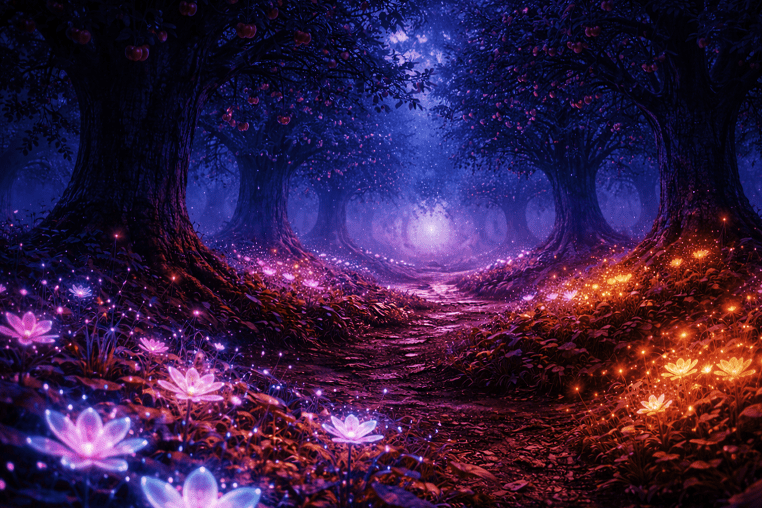
 They call it the Isle of Apples.
In older tongues, it was named Avalon — the orchard beyond grief, the shore beyond war, the resting place of kings. In medieval accounts such as the Historia Regum Britanniae, it is described as a place of healing, abundance, and supernatural grace. A utopia.
A paradise.
A fairy realm.
But the deeper the archives are searched, the less simple that paradise becomes.
Today, in pursuit of further knowledge, many countries are not only scanning satellites and seismic readings. They are turning backward — into myth, into literature, into humanity’s collective memory. They are tracing symbols. Comparing folklore. Mapping recurring motifs across civilizations.
They are not merely studying the present collision.
They are searching for proof that it has happened before.
And perhaps they have found something.
Fragments suggesting that long before Destia’s shadow brushed this world, another realm once touched Terra. Not through war. Not through conquest. But through convergence.
Avalon.
A utopia where pain and fear, hatred and love supposedly ceased to exist. A realm where nature was not passive but embodied — walking, whispering, watching. The Fae.
There are few trustworthy written records. Outside restricted archives, references are poetic, fragmented, or dismissed as allegory. Yet across cultures, echoes persist:
-
Islands hidden by mist
-
Apples granting immortality
-
Forests that swallow wanderers whole
-
Time flowing differently beyond the veil
-
Bargains struck with beings not quite human
These are not isolated myths. They are patterns.
And patterns are scars.
If a previous collision occurred — if Avalon once overlapped with Terra — it would not have left clean documentation. It would have left distortions. Psychological residues. Linguistic anomalies. Ritual warnings embedded in nursery tales.
A paradise described as free from suffering.
Yet also a realm where nightmares take form.
Because what is a fairy realm, truly?
If emotion is discarded, what remains of the human?
If pain is surrendered, does identity survive?
Some suppressed accounts hint at darker interpretations — that Avalon was not merely a sanctuary but a transformation. That those who vanished into the mist did not simply rest.
They became part of it.
Trees watered not by rain alone, but by sacrifice.
Apples nurtured not merely by soil, but by something more intimate.
The Fae — described as embodiments of nature — were neither benevolent nor cruel in human terms. They operated by other laws. Transactional. Precise. Unburdened by morality as we define it.
A collision between worlds is not always explosive.
Sometimes it is seductive.
Avalon may have been one such convergence — a realm promising eternal peace in exchange for temporary pain.
“What is temporary suffering for eternal serenity?” they are said to have whispered before stepping into the mist.
And then they were gone.
If that era of collision ended, it did not end cleanly.
There are still stories that refuse to fade.
Still forests that feel older than the soil beneath them.
Still orchards whose fruit is avoided without knowing why.
Still dreams of islands where time does not move correctly.
Governments studying Destia’s approach are reportedly examining these myths not as fantasy, but as precedent. If Avalon was a prior overlap — a utopian incursion masked as legend — then Destia may not be the first.
And it will not be the last.
Avalon was called paradise.
But paradise, when examined closely, often demands a cost.
A resting place of the suffering.
A realm where one may discard human emotion and dissolve into eternal nature.
Perhaps as part of the forest.
Perhaps as nourishment for it.
Perhaps as something no longer human at all.
And if the collision cycle has begun again, the remnants of Avalon may resurface — not as fairy tales, but as structural weaknesses in reality.
Scars that never fully healed.
Because even utopias leave ruins.
Even mist cannot silence every scream.
And somewhere, beneath the shifting noise of the Black and the approaching presence of Destia, the Isle of Apples waits — not vanished, merely dormant.
A reminder that collisions do not always arrive with fire.
Sometimes they arrive as an invitation.