
 Written by
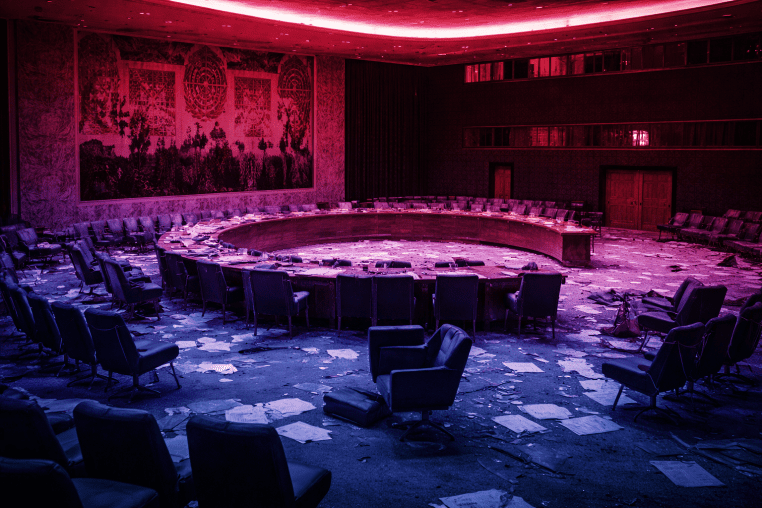
 An informal meeting of the United Nations Security Council, held under the Arria Formula, carries a title that sounds academic:
“The Information Dimension of the Ukrainian Crisis: How Media Narratives Shape Conflict.”
It reads like media theory.
It sounds procedural.
Unofficial. Exploratory. Informal.
But language matters.
When the Council invokes “dimension,” it is not accidental.
What dimension?
What tension?
What crisis?
What narrative?
On the surface, the discussion concerns information warfare, propaganda ecosystems, digital influence operations surrounding the war in Ukraine. It intersects with broader geopolitical tensions — debates over U.S. foreign policy posture, instability in Sudan, shifting alliances, fractured global trust in media systems.
All of that is real.
All of that is visible.
And all of that is convenient.
Because across multiple regions — conflict zones, politically unstable territories, high-surveillance states — something else has been observed: irregular narrative convergence.
Not coordinated messaging.
Convergence.
Unrelated actors repeating symbolic structures without shared origin. Media fragments carrying identical abstract metaphors across opposing ideological camps. Visual distortions embedded in broadcast feeds that analysts struggle to attribute to compression artifacts.
An “information dimension” is, officially, the battlefield of perception.
Unofficially, it may refer to something less metaphorical.
If the collision with Destia has created permeability — if the Black’s flow has shifted and opened scars in reality — then information becomes the most efficient entry point.
Not matter.
Not armies.
Signal.
Things from outside this world do not need physical mass to infiltrate.
They need pattern.
Human cognition is pattern-driven. Introduce subtle distortions into narrative streams and you do not invade territory — you invade interpretation.
Recent geopolitical tensions have displayed unusual informational properties:
-
Escalations triggered by symbolic misreadings rather than strategic miscalculations
-
Viral content with origin points that cannot be conclusively mapped
-
Simultaneous surges of emotionally charged imagery across unlinked regions
-
Language patterns that appear constructed to destabilize coherence rather than persuade
Governments call it disinformation.
But disinformation presumes human authorship.
What if the pattern is not persuasion, but interference?
If Destia’s convergence has opened informational seams — microscopic fractures in cognitive bandwidth — then the Black’s colorful noise may not manifest as static alone. It may manifest as amplified narrative chaos.
Stories that destabilize.
Symbols that bypass logic.
Concept clusters that distort collective perception.
The Arria Formula is used for informal, exploratory dialogue outside formal resolutions. It allows states to discuss emerging threats without binding commitments.
What are they truly discussing?
Perhaps not just media narratives.
Perhaps cognitive anomalies.
Perhaps pattern intrusions detected across diplomatic communications.
Perhaps signals embedded in public discourse that do not map cleanly onto known propaganda infrastructures.
What are they guarding against?
Mass hysteria is one possibility.
But so is contamination.
If narrative systems become vectors for external interference — if something beyond human comprehension is attempting to establish foothold through distortion — then controlling the “information dimension” becomes existential rather than political.
The U.S. debates foreign policy direction. Sudan navigates internal crisis. Europe recalibrates security doctrines. Asia fortifies digital firewalls.
On the surface, these are geopolitical tensions.
Beneath, they may be defensive measures against cognitive bleed.
The collision is not only orbital.
It is perceptual.
A gate in reality does not merely allow entities to pass.
It allows influence.
And influence does not require visibility.
If the Council is using neutral language to mask abnormal data, it would not be unprecedented. Governments rarely announce that the laws of perception appear to be under stress.
They reframe.
They reclassify.
They call it narrative.
We will not know immediately what was truly discussed.
Informal meetings leave limited public trace.
But watch for follow-up language:
-
Increased emphasis on “resilience of information ecosystems”
-
Sudden cross-national cognitive security initiatives
-
Expanded monitoring of symbolic extremism beyond traditional propaganda
-
Quiet investments in neurolinguistic pattern analysis
What dimension?
The one overlapping ours.
What tension?
The strain between human perception and external interference.
What crisis?
A cognitive battlefield emerging from a physical collision.
What narrative?
The attempt to preserve coherence in a world where coherence is no longer guaranteed.
The Black does not shout.
It refracts.
And those charged with guarding global stability may now be guarding something far less tangible than borders.